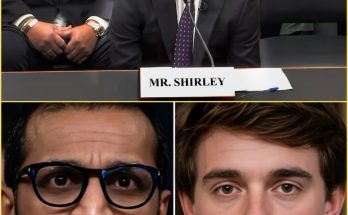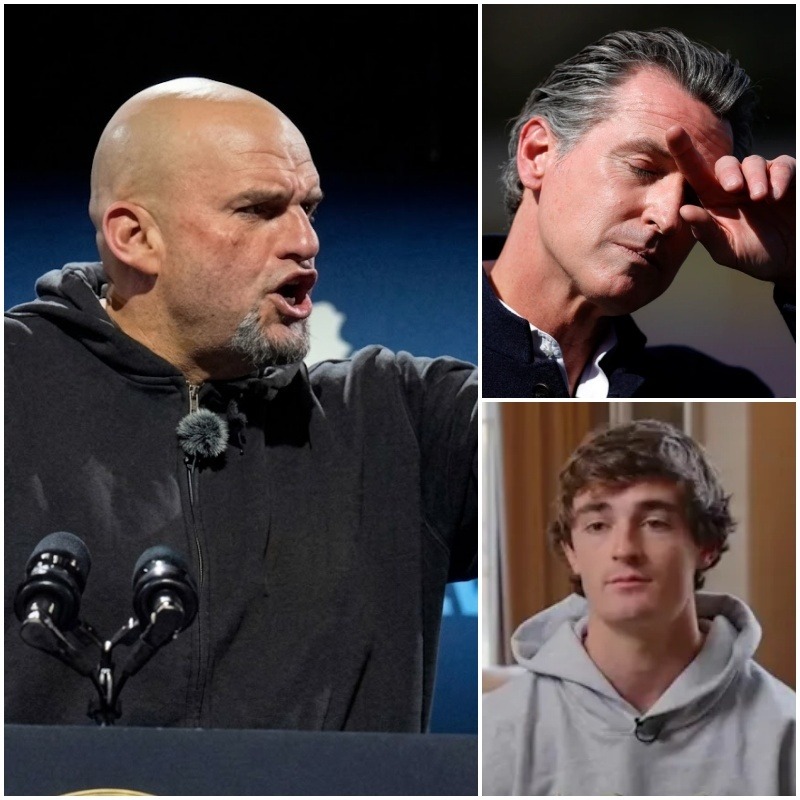

At the center of the controversy is U.S. Senator John Fetterman, who has once again stepped outside traditional party lines—this time directing sharp criticism toward Gavin Newsom. The clash was sparked by reactions from Newsom’s office to reporting by independent journalist Nick Shirley, whose recent investigation has ignited debate across political and media circles.
A Viral Investigation Sparks Controversy
Shirley’s report, widely circulated online, claims to expose alleged fraud, waste, and mismanagement within certain California-funded programs. The video includes footage of facilities described as underutilized or non-operational, accompanied by commentary suggesting systemic inefficiencies in the allocation of public funds.
Within hours of gaining traction, the investigation drew intense public attention, particularly among audiences already skeptical of government spending. Social media platforms amplified the video’s reach, turning it into a focal point for broader discussions about accountability in state programs.
However, while the public reaction was swift, the political response proved even more charged.

Fetterman Breaks Ranks
In remarks that quickly became a flashpoint, Fetterman openly challenged how Shirley was characterized by Newsom’s camp. According to statements attributed to the Pennsylvania senator, he took issue not only with the tone of the criticism but also with what he viewed as a dismissal of legitimate scrutiny.
“Why can’t you celebrate someone exposing waste?” Fetterman reportedly said, a comment that has since been widely quoted and dissected.
The statement marked a rare and notable instance of intra-party disagreement. While political figures often present a unified front, particularly when facing external criticism, Fetterman’s remarks suggested a willingness to publicly diverge on matters of principle.
Observers noted that his stance aligns with a broader pattern in his political approach—one that occasionally challenges party orthodoxy in favor of positions he frames as pragmatic or grounded in public sentiment.
Newsom’s Camp Pushes Back
On the other side of the dispute, representatives associated with Newsom have expressed skepticism toward both the framing and implications of Shirley’s investigation. While not dismissing concerns about oversight outright, they have questioned whether the video presents a complete and accurate picture.
Critics of the investigation argue that short-form viral content can lack necessary context, potentially leading to misinterpretation of complex policy issues. They caution that selective footage, without accompanying data or institutional perspective, may oversimplify challenges inherent in large-scale public programs.
This divergence in response highlights a key tension: whether investigations conducted outside traditional media institutions should be treated with the same credibility—or skepticism—as established journalistic reporting.
A Broader Debate Over Accountability
Beyond the immediate personalities involved, the controversy has opened a wider conversation about how allegations of public fund misuse should be handled—and who gets to shape the narrative around them.
For some analysts, Fetterman’s defense of scrutiny—regardless of its source—reflects growing pressure within political circles to address public frustration over government spending. In this view, embracing transparency, even when politically inconvenient, may be seen as a strategic effort to maintain credibility with voters.
Others interpret the situation differently, suggesting that the dispute reveals underlying divisions within the party about communication strategy. Should leaders challenge potentially misleading narratives head-on, or risk legitimizing them by engaging?
The Role of Independent Journalism

Nick Shirley’s role in the controversy has also become a subject of debate. Supporters portray him as a watchdog figure, willing to highlight issues that might otherwise go unnoticed. They argue that independent journalism can serve as a vital check on institutional power, particularly in the digital age where traditional gatekeepers are less dominant.
Critics, however, question the methodology and rigor of such reporting. Without the editorial standards and verification processes typically associated with established media outlets, they argue, independent investigations may blur the line between legitimate inquiry and advocacy.
This divide underscores a broader shift in the media landscape, where viral content can shape public discourse as powerfully as traditional reporting—if not more so.
Political Messaging and Public Trust
As the dispute continues to unfold, it is increasingly clear that the issue extends beyond a single video or even a single policy debate. At its core, the conflict touches on fundamental questions about messaging, trust, and political identity.
Fetterman’s remarks suggest a belief that acknowledging and addressing concerns—regardless of their origin—may strengthen public trust. In contrast, the more cautious response from Newsom’s camp reflects concerns about amplifying narratives that may lack full context.
The tension between these approaches illustrates a broader challenge facing modern political leaders: navigating an information environment where speed, perception, and credibility are constantly in flux.

An Intra-Party Conflict With Wider Implications
While disagreements within political parties are not uncommon, the public nature of this dispute has drawn particular attention. It highlights how issues of transparency and accountability can cut across ideological lines, creating unexpected alliances and conflicts.
For voters, the episode may serve as a window into how leaders respond when confronted with allegations of mismanagement—whether they prioritize unity, scrutiny, or strategic messaging.
For the Democratic Party, the moment represents a test of how to balance internal debate with external cohesion.
One thing, however, is certain: what began as a viral video has evolved into something much larger.
It is no longer just about allegations of waste.
It is about who gets to question power.
It is about how those questions are received.
And ultimately, it is about how trust is built—or eroded—in an era where every narrative can become a battleground.