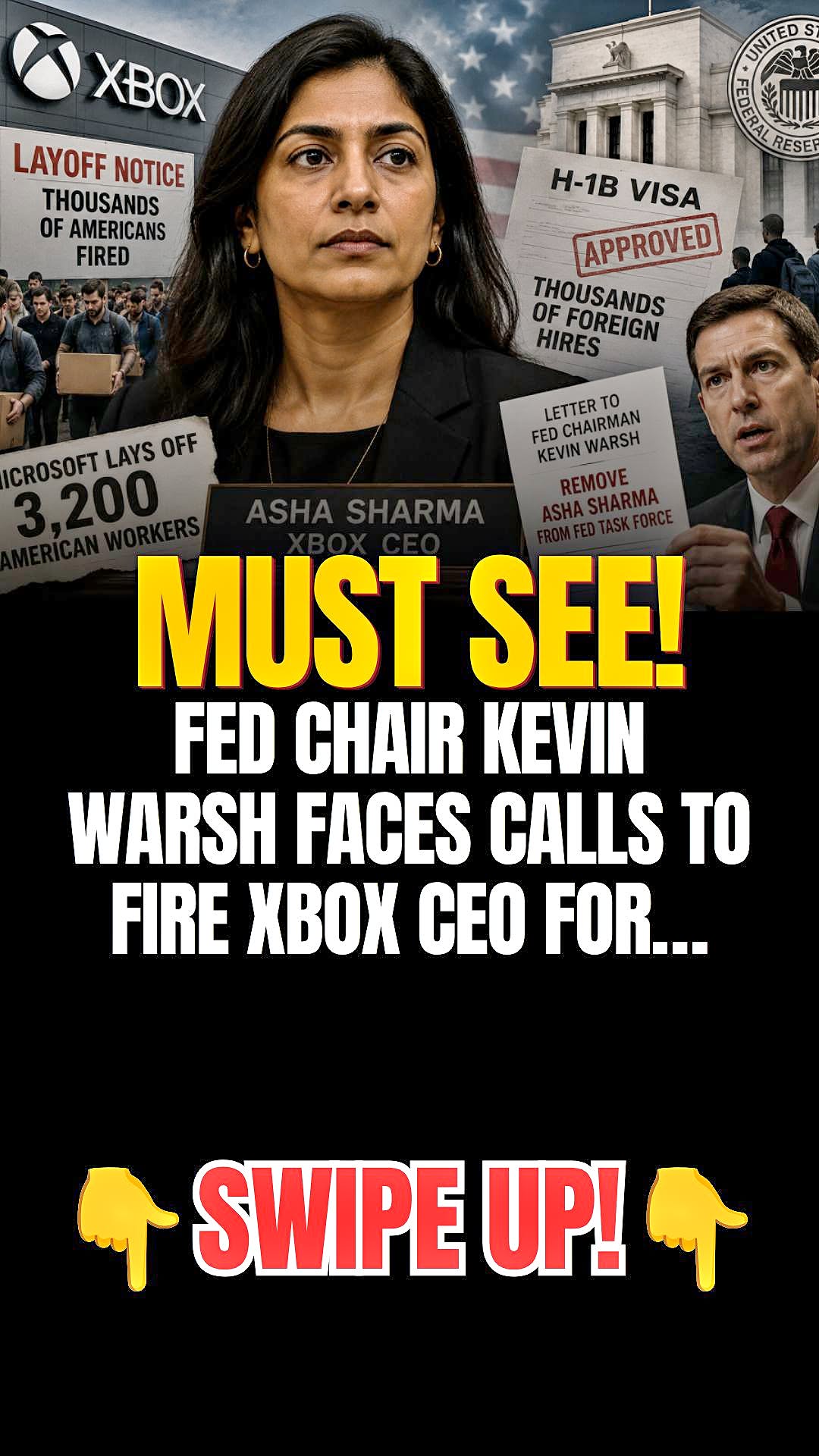

Federal Reserve Chairman Kevin Warsh is facing mounting pressure from Capitol Hill to remove Xbox CEO Asha Sharma from a Fed task force focused on productivity and jobs after revelations that her division laid off thousands of American workers while pursuing foreign visa hires. The controversy has quickly become a flashpoint in the broader national debate over corporate America’s use of the H-1B visa program.

West Virginia Congressman Riley Moore fired off a letter to Warsh this week demanding that Sharma be removed from the task force entirely. Moore did not hold back, saying he wanted her removed outright and questioning what kind of strategy involves firing your own workforce and then applying for visas to bring in foreign labor instead.
The controversy stems from Microsoft’s decision to cut thousands of jobs across its gaming division under Sharma’s leadership, with an additional 3,200 positions eliminated just weeks ago as part of a broader restructuring. At the same time, reports surfaced that the company filed for thousands of H-1B visa positions this year, feeding perceptions that American workers were shown the door while foreign labor was brought in through the back.
Sharma was tapped by Warsh earlier this year to co-lead the Federal Reserve’s Productivity and Jobs Task Force, a panel meant to study how emerging technologies like artificial intelligence are reshaping the American economy and workforce. The appointment raised eyebrows from the start, given that the very executive advising the Fed on jobs policy was simultaneously overseeing mass layoffs at her own company.
Moore, who sits on the House Financial Services Committee, argued that Sharma’s dual role represents a glaring conflict of interest. As the head of Productivity and Jobs on a Fed advisory panel, he questioned how someone actively cutting American jobs while pursuing foreign visa labor could credibly advise the nation’s central bank on employment policy.
The congressman has also renewed his call to eliminate the H-1B visa program altogether, describing it as a scam that allows companies to replace American workers with cheaper foreign labor under the guise of filling skills gaps. That view has gained significant traction among conservatives in recent months as tech layoffs have piled up even as visa applications for foreign workers have climbed.
Sharma took over as CEO of Microsoft Gaming and Xbox earlier this year following the retirement of longtime Xbox chief Phil Spencer, who spent 38 years with the company. Her background is rooted heavily in artificial intelligence rather than gaming, having previously led Microsoft’s Core AI product division and held roles at Meta and Instacart, a resume that has already drawn skepticism from longtime Xbox fans who question whether she understands the industry she now leads.
Since taking the helm, Sharma has struggled to right a division that critics say has become bloated through years of acquisitions and has posted mounting losses, including a failed bet on cloud game streaming. Xbox has reportedly fallen far behind Sony’s PlayStation in hardware sales this generation, with some estimates suggesting it has sold barely a third as many consoles.
Against that backdrop, her decision to pursue thousands of H-1B visa hires even as American employees were shown the door has struck many, including lawmakers, as tone-deaf at best and cynical at worst. Warsh himself has described the Fed’s new task forces as an effort to bring outside expertise to the central bank as it examines how new technologies affect its employment and inflation mandates.
Sharma sits alongside other prominent figures on the panel, including venture capitalist Marc Andreessen, a leading voice in Silicon Valley’s push for aggressive AI adoption. That pairing has only heightened concerns among critics that the task force is stacked with executives who have a financial interest in automation and offshoring rather than genuine advocates for American workers.
Social media users piled on almost immediately after Sharma’s appointment became public, with one widely shared post questioning why someone tied to mass layoffs and foreign visa hiring should be advising the Federal Reserve on jobs policy at all. Another post pointed out that Sharma announced firing 3,200 Americans around the same time her company sought roughly 5,000 H-1B visas this year.
The Federal Reserve has not indicated any plans to reconsider Sharma’s role on the task force despite the mounting pressure. That silence is likely to frustrate Republicans on Capitol Hill who have grown increasingly vocal about the need to protect American jobs from what they view as an out of control visa system that prioritizes corporate cost cutting over the interests of everyday workers.
Moore’s letter adds a new congressional dimension to a controversy that had, until now, largely played out in corporate press releases and social media commentary. By formally petitioning the Fed chairman, Moore is attempting to force the issue into the realm of official oversight rather than leaving it as a talking point that fades from the news cycle.
The broader debate touches on a theme that has animated conservative politics for years: the tension between corporate America’s embrace of globalized, cost driven labor practices and the interests of the American workers those companies were built to employ. Sharma’s situation has become something of a case study for critics who argue that too many corporate executives view American employees as expendable while foreign labor is treated as a cost saving tool.
Republicans have increasingly zeroed in on the H-1B program as a symbol of that broader imbalance, arguing that it was never intended to be used as a mechanism for wholesale workforce replacement but rather a narrow tool for filling genuine skills shortages. Critics say companies like Microsoft have stretched that original intent well beyond recognition.
Whether Warsh ultimately bows to the pressure and removes Sharma from the task force remains to be seen. The Fed has traditionally guarded its independence from political pressure, and Warsh may be reluctant to set a precedent of removing task force members based on congressional demands, however justified those demands may be in the eyes of critics.
Still, the optics of the situation remain difficult to defend. A task force ostensibly created to study how the Fed can better support American jobs now includes an executive whose own company is simultaneously laying off thousands of American workers while pursuing thousands of foreign visa hires. That contradiction is not lost on the lawmakers now demanding accountability.