

A renewed wave of controversy has erupted on Capitol Hill as lawmakers intensify scrutiny over newly surfaced email exchanges linked to Jeffrey Epstein.
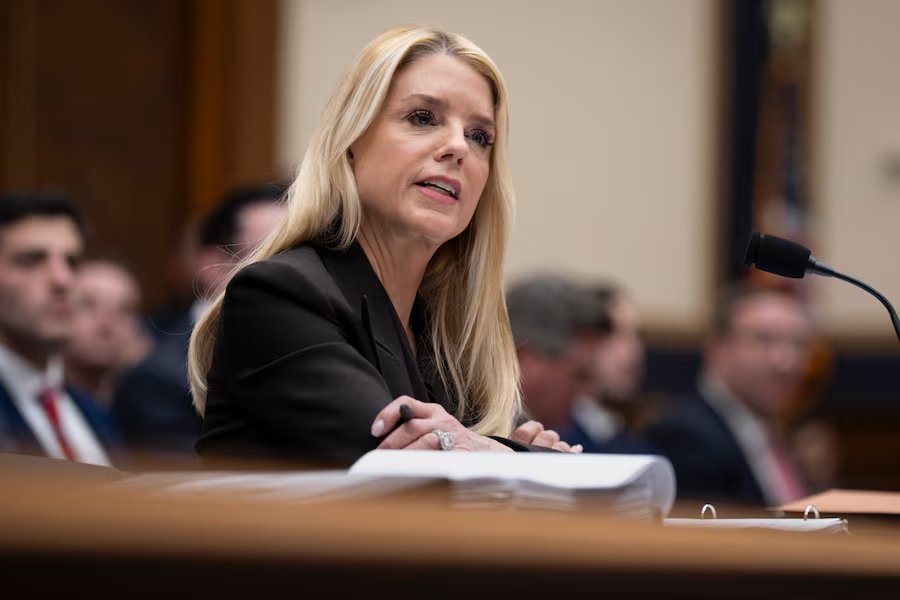
At the center of the storm is Pam Bondi, who faced pointed questions during a tense hearing that quickly captured national attention.
The situation has been further complicated by references to Steve Tisch, whose name has emerged in connection with the email revelations.
According to reports discussed during the hearing, the emails contain references to arrangements involving women, including classifications such as “pro” and “civilian,” along with language that some observers interpret as suggesting emotional pressure.
While the full context and authenticity of these communications have not been publicly verified in detail, their content has been enough to ignite intense debate among lawmakers, legal experts, and the public.
The controversy reached a boiling point when members of Congress, including Ted Lieu and Eric Swalwell, pressed Bondi for answers regarding what they described as a lack of clear investigative action.
Their questioning reflected growing frustration over what some perceive as delays, inconsistencies, or hesitations in addressing allegations tied to Epstein’s network.

For many observers, the hearing highlighted a broader issue: the challenge of navigating highly sensitive information within complex legal and political frameworks.
Cases connected to Epstein have long been surrounded by secrecy, sealed documents, and incomplete disclosures.
As a result, each new revelation-whether confirmed or alleged-tends to trigger renewed calls for transparency and accountability.
Bondi, who has maintained a prominent public profile due to her legal career and past involvement in high-profile cases, found herself under intense pressure to explain how such matters are being handled.
While she did not make definitive statements regarding the specifics of the emails, her responses emphasized the importance of legal process, evidentiary standards, and institutional constraints.
Supporters of Bondi argue that investigations of this magnitude require careful handling to avoid compromising potential legal proceedings.
They caution against drawing conclusions based on incomplete or unverified information, noting that public hearings are not always the appropriate venue for disclosing sensitive investigative details.
Critics, however, see the situation differently.
They contend that the lack of clear answers only deepens public suspicion and undermines trust in institutions tasked with delivering justice.
For them, the emergence of new names and alleged communications reinforces the need for a more aggressive and transparent approach.
The mention of Steve Tisch has added another layer of complexity to the unfolding story.
As a well-known figure in business and entertainment, his reported connection-however indirect-has drawn significant attention.
It also underscores how far-reaching the Epstein network may have been, touching individuals across various industries and sectors.
Legal analysts observing the developments have emphasized that email evidence, while potentially significant, must be carefully authenticated and contextualized.
The interpretation of phrases, classifications, and tone can vary widely depending on circumstances, and without full documentation, conclusions remain speculative.

At the same time, the political dimension of the hearing cannot be ignored.
High-profile cases involving influential figures often become battlegrounds for broader ideological conflicts.
Lawmakers may use such moments to highlight concerns about accountability, governance, and the rule of law-issues that resonate strongly with the public.
The convergence of sensitive disclosures, institutiorial caution, and mounting public pressure has created a volatile environment.
Each new detail adds to the narrative, shaping perceptions even before formal legal determinations are made.
In an era where information spreads rapidly, the line between verified fact and emerging allegation can quickly blur.
Despite the intensity of the hearing, many key questions remain unanswered.
What exactly do the emails reveal when viewed in full context?
Are there additional documents that have yet to be made public?
And perhaps most critically, will these developments lead to concrete legal action?
For now, the situation continues to evolve.
The hearing has ensured that the issue remains firmly in the national spotlight, with calls for further investigation growing louder.
Whether those calls result in tangible outcomes will depend on a range of factors, including the availability of evidence, legal strategy, and political will.
What is clear, however, is that the Epstein case-long considered one of the most complex and controversial in recent history-still has the power to generate headlines, provoke debate, and challenge institutions.
The emergence of new alleged connections only reinforces the sense that the full story may not yet be known.
As lawmakers, investigators, and the public continue to seek clarity, the demand for transparency remains at the forefront.
In a case defined by secrecy and unanswered questions, each new development carries the potential to reshape understanding and to determine whether accountability will ultimately be achieved.