
The Incident That Ignited a League-Wide Conversation
In professional basketball, consistency is the fundamental bedrock of officiating integrity. Players, coaches, and spectators accept that calls will occasionally be missed or misinterpreted in the heat of fast-paced competition. However, what the sporting world finds far harder to reconcile is the perception of uneven enforcement—where identical or far more egregious actions produce dramatically different consequences depending on who happens to be wearing the jersey.
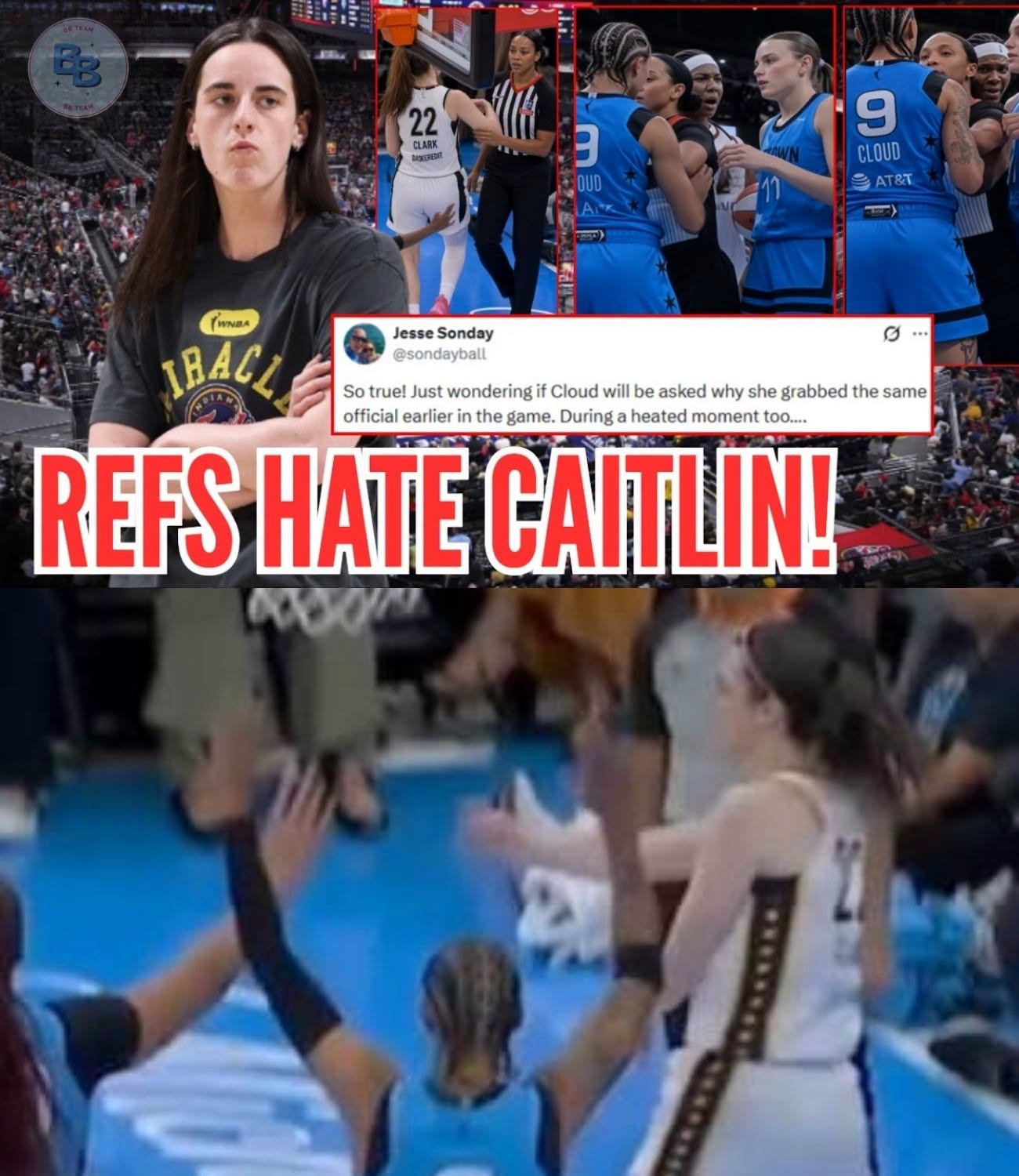
A recent sequence of events surrounding Indiana Fever phenom Caitlin Clark and referee Jennese Diamond has brought this delicate topic directly under the media spotlight. During a high-stakes match, Clark found herself on the receiving end of a technical foul that left commentators, teammates, and millions of viewers utterly bewildered. The play unfolded near the baseline: Clark was bumped out of bounds by defensive pressure from Natasha Cloud, carrying her momentum directly toward the baseline official. Unable to stop her forward motion, Clark bumped into referee Jennese Diamond.
Rather than recognizing the contact as purely incidental and resultant from an uncalled physical collision on the play, the official issued an immediate technical foul against Clark. The whistle was blown with a noticeable delay, leading many analysts to question whether the call was driven by a momentary reaction rather than a strict application of the rulebook. For Clark, who was already walking a dangerous line regarding technical foul accumulation toward an automatic league suspension, the call carried immense consequences for her team’s season trajectory.
The Uncovered Footage: A Stark Contrast in Enforcement
What turned a controversial call into an outright league-wide debate was the subsequent release of additional video footage from the same game. Sports analysts and eagle-eyed fans examining game film discovered a second, far more direct interaction involving the exact same referee, Jennese Diamond, and rival player Natasha Cloud.
In the newly uncovered footage, Natasha Cloud is seen engaged in an intense verbal altercation on the floor. In an attempt to position herself to continue arguing with an Indiana Fever player, Cloud physically reaches out, placing her hands underneath the referee’s arms to physically lever and push the official out of her way. Unlike the accidental, momentum-driven contact between Clark and the referee, Cloud’s gesture was deliberate, physical, and performed for the explicit purpose of moving an official out of her path.
Yet, despite this clear and intentional physical contact, no whistle was blown. No technical foul was assessed. Cloud was allowed to continue her confrontation uninterrupted, leaving observers to ponder an inescapable question: Why does accidental contact result in a punitive whistle for one player, while intentional physical contact by another goes completely unpunished by the very same official?
Understanding the Officiating Pattern Surrounding Caitlin Clark
To fully appreciate why this specific incident struck such a raw nerve with fans and commentators alike, one must contextualize it within Caitlin Clark’s broader experience during her inaugural and sophomore campaigns in the WNBA. Since entering the league as one of the most celebrated and highly scrutinized prospects in basketball history, Clark has accumulated a uniquely bizarre collection of technical fouls.
A quick review of Clark’s technical foul resume highlights a series of calls that range from the questionable to the downright absurd:
The Clapping Technical: A whistle assessed simply for clapping her hands together in reaction to a sequence on the floor.
The Ball-Handling Whistle: A technical call received after kicking the ball up to herself to hand it back to an official.
The Emotion/Stanchion Contact: Whistles handed down for slapping the padded goal stanchion out of frustration with her own play.
The “Scoreboard” Remark: A technical assessed after Clark pointed toward the arena scoreboard during an exchange of words.
While emotion and passion are inherent to top-tier athletic competition, observers have repeatedly pointed out that Clark frequently absorbs physical contact—including heavy hand-checks, uncalled flagrant contact, and hard baseline hits—without receiving whistle protection from game officials. When a player who routinely withstands heavy physical play is suddenly whistled for a technical foul after being pushed into a referee, public frustration naturally reaches a boiling point.
Post-Game Reactions and League Intervention
Following the game, media attention immediately shifted to the post-game press conference room, where both Clark and Indiana Fever head coach Stephanie White addressed the media regarding the baseline incident.
When asked about the explanation provided on the floor for the whistle, Clark remained composed yet candid about what transpired. She explained that the official informed her that the technical was assessed specifically for intentionally making contact with the referee. Clark clarified that she was falling backward from the out-of-bounds play and had no situational awareness that an official was standing directly behind her path of movement. She expressed confidence that game film would clearly validate her account of the event and noted that an appeal was already being prepared.
Coach Stephanie White also voiced significant frustration with the call, pointing out that incidental contact occurs regularly during chaotic, fast-break, or out-of-bounds plays. She emphasized that officials must possess situational awareness and understand the physical dynamics of momentum before issuing game-altering penalties.
The outcome of the formal appeal process came swiftly. Upon reviewing the multi-angle game film, WNBA league officials formally rescinded the technical foul assessed to Caitlin Clark. The rescission spared Clark from penalty points that would have triggered an automatic game suspension—a outcome that carried massive implications not just for the Indiana Fever’s playoff push, but also for national broadcast networks preparing to showcase upcoming marquee matchups featuring the star guard.
National Media and the Commercial Reality of WNBA Officiating
The controversy also highlighted a compelling intersection between league administration, broadcasting partnerships, and referee oversight. During the live broadcast, seasoned play-by-play announcer Ryan Ruocco and analyst Rebecca Lobo openly discussed the high-stakes implications of Clark’s technical foul tally. With major national broadcasts scheduled on prime television slots, a suspension for the league’s primary ratings driver would have had significant economic and viewership consequences for broadcasting networks like ESPN.
While the league’s primary duty is to uphold fair play and rule enforcement regardless of television ratings, the rapid rescission of the technical foul demonstrated that administrative review mechanisms can—and must—correct obvious errors made on the floor. However, the root problem remains: why are such calls happening on the floor in the first place?
The contrast between Clark’s rescinded call and the unpenalised contact involving Natasha Cloud serves as an urgent case study for WNBA officiating leadership. As women’s basketball experiences unprecedented commercial growth, fan engagement, and cultural prominence, the standards of officiating must evolve at an equal pace. Ensuring that rules are applied uniformly, without bias, fear, or favoritism, is essential for maintaining the credibility of the sport moving forward.