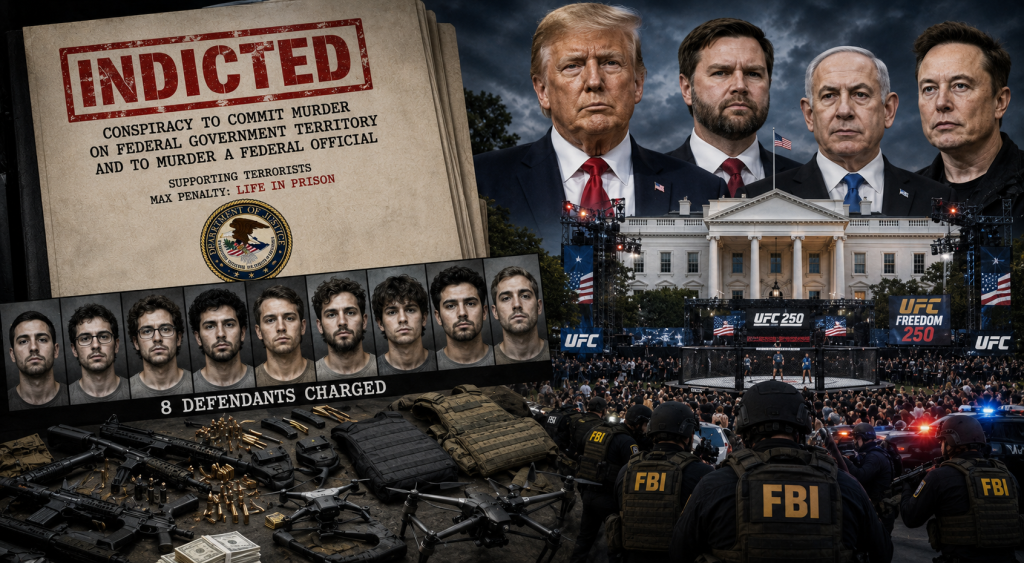

A federal grand jury has handed down indictments against eight men accused of plotting a coordinated terror attack designed to murder President Donald Trump, Vice President JD Vance, Israeli Prime Minister Benjamin Netanyahu, Elon Musk, and other high-value targets at the White House.
The plot, which law enforcement says was disrupted before it could be carried out, represents one of the most serious domestic terrorism cases to reach federal court in years.
The indictment, returned in Columbus, Ohio, charges all eight defendants with two separate conspiracies. The first count accuses the men of conspiring to provide material support to terrorists. The second, far more serious charge, accuses them of conspiring to commit murder on federal government territory and to murder a federal government official.
The material support charge carries a maximum penalty of up to fifteen years in prison, while the murder conspiracy charge can result in a life sentence.
According to the Justice Department, the plot was aimed squarely at the UFC Freedom 250 event held on the South Lawn of the White House on June 14, an occasion that doubled as a celebration of President Trump’s 80th birthday and the 250th anniversary of American independence. Thousands of guests, including senior Republican lawmakers, administration officials, and major donors, attended the invite-only event, with tens of thousands more watching from surrounding grounds.
Federal prosecutors allege the defendants set their sights on an extraordinary list of targets. The men allegedly planned to murder President Trump, Vice President Vance, U.S. officials, Prime Minister Netanyahu, Elon Musk, and other high-value targets at the event.
Netanyahu ultimately did not attend, but the scope of the intended violence underscores just how far these radicals were willing to go.
Investigators say the conspiracy did not emerge overnight. According to the indictment, the plotting began in May, months before the scheduled event, giving the defendants time to organize logistics, recruit additional participants, and stockpile resources for the assault. The alleged conspiracy involved far more than idle chatter online. Prosecutors say the men conspired to funnel money, firearms, ammunition, body armor, explosives, drones and even medical equipment toward the operation, treating the plot with the seriousness of a paramilitary campaign rather than a fringe fantasy.
The alleged attack plan itself reads like something out of a worst-case scenario briefing. According to federal authorities, the men intended to use drones to create chaos and a diversion, then unleash snipers on attendees as they attempted to flee the White House grounds. One of the defendants, Chandler D. Scaggs of West Virginia, was allegedly assigned specifically to serve as one of the snipers in the operation.
The case first came to light last month when FBI Director Kash Patel announced that a multistate law enforcement operation had successfully thwarted the attack before it could unfold. Patel revealed that federal authorities became aware of the plot on June 10 after monitoring encrypted communications on the Signal messaging platform, a break that likely prevented what could have been a catastrophic loss of life at the heart of American government.
The FBI’s swift action led to a wave of arrests in the days surrounding the UFC event. Five men were taken into custody the same weekend the fight took place, with law enforcement moving quickly across multiple states including Ohio, Missouri, Washington, Nebraska and California. Two additional suspects were arrested roughly a week later. The eighth and final defendant, Scaggs, was not taken into custody until this week, when he was arrested in West Virginia, closing out what had been a coast-to-coast manhunt.
What makes this case particularly alarming is how the alleged conspirators organized themselves. According to the Justice Department, the defendants relied heavily on encrypted and semi-anonymous platforms to coordinate their plans, including Signal, SimpleX, and Discord, while also leveraging mainstream social media platforms like TikTok and Instagram to recruit new members into their orbit.
This blend of encrypted planning tools and public-facing radicalization platforms mirrors a disturbing pattern that has become increasingly common among domestic extremist networks in recent years.
One of the accused ringleaders, identified as Tycen J. Proper, a 19-year-old from Danville, Ohio, reportedly told FBI investigators during a June 11 interview that he had participated in planning the attack. According to reporting on the case, Proper revealed that the group’s communications originated in a TikTok chat group before migrating to more secure platforms, illustrating how easily radicalization can begin on the very apps millions of American teenagers use every day.
The full roster of defendants named in the indictment includes Abraham H. Alvarez, Daniel K. Eskridge, William L.S. Falkner, Tycen J. Proper, Jordan W. Rincker, Bryan O. Roa, Chandler D. Scaggs and Michael A. Thomas. Prosecutors allege that Alvarez played a leading role in orchestrating the planning behind the attack, though all eight now face the same consolidated set of federal charges following Thursday’s indictment.
An attorney representing Proper has already signaled that his client intends to fight the charges. Joseph Patituce, the attorney representing Proper, said his client will enter a plea of not guilty and asked the public to remember that Proper, at 19, is the youngest of those charged.
Whether that argument gains any traction with a jury remains to be seen, but given the gravity of the allegations, few expect leniency from federal prosecutors.
This case lands squarely within a broader and deeply troubling trend of escalating political violence targeting conservative leaders and institutions. In an era where rhetoric on the left has increasingly dehumanized the president and his allies, it should surprise no one that a small but dangerous fringe has decided to act on that hatred.
The alleged plot to gun down the sitting president, the vice president, and a key foreign ally at a public celebration of American independence is as brazen as domestic terrorism gets.
It is also worth noting the symbolism the plotters allegedly chose to attack. The UFC event at the White House was meant to be a showcase of American strength and unity, timed to coincide with the nation’s 250th birthday.
That the accused conspirators allegedly viewed this celebration as an opportunity for mass murder speaks to the depth of radicalization now metastasizing in corners of the internet that too often escape scrutiny until it is nearly too late.
Law enforcement officials deserve real credit here. The operation to identify, track and dismantle this network before a single shot was fired stands as a genuine success story for federal counterterrorism efforts under the current administration.
FBI Director Kash Patel’s early public disclosure of the thwarted plot, followed by the methodical work of federal prosecutors to build a case strong enough to secure a grand jury indictment, reflects the kind of vigilance the moment demands.