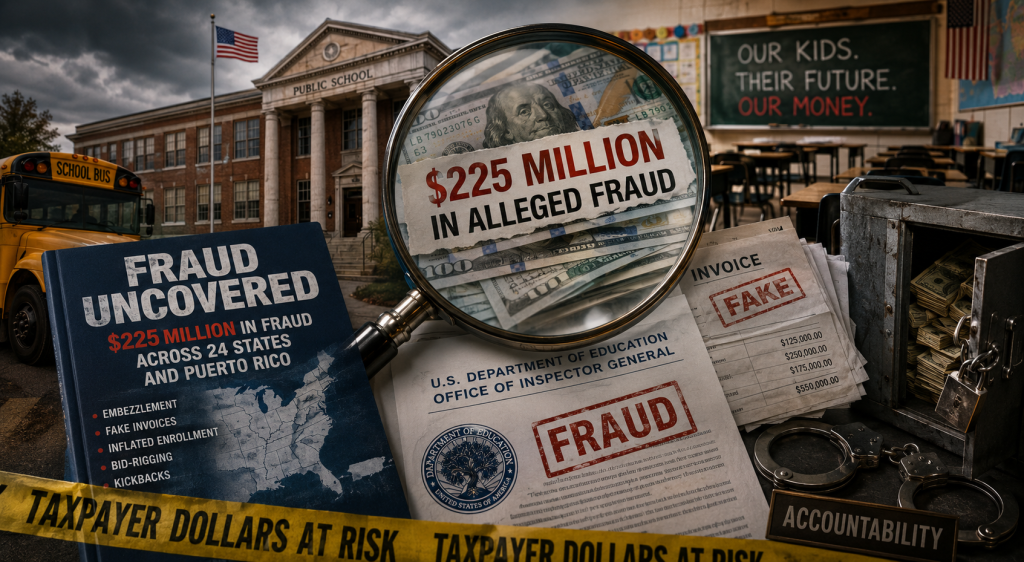

A bombshell new report has uncovered roughly $225 million in alleged fraud spread across public and charter schools in 24 states and Puerto Rico, exposing a sprawling pattern of embezzlement, fake invoices, inflated enrollment figures, bid-rigging, and kickbacks that critics say has been allowed to fester for years due to weak oversight.
The findings arrive as the Trump administration ramps up its broader crackdown on government waste and fraud, and they should serve as a wake-up call for parents, taxpayers, and state lawmakers across the country.
The report was produced jointly by the State Financial Officers Foundation, a coalition of state treasurers and financial officers, and Open the Books, a nonpartisan government spending watchdog group known for digging through federal records that most Americans never see. Together, the two organizations combed through every single Semiannual Report to Congress issued by the U.S. Department of Education’s Office of Inspector General between October 1, 2019, and March 31, 2026, nearly six and a half years of federal oversight documents. What they found was staggering.
Investigators identified almost 90 separate cases of fraud embedded within the nation’s K-12 education system, ranging from small-scale embezzlement by individual district employees to sprawling multimillion-dollar schemes involving entire charter school networks. OJ Oleka, CEO of the State Financial Officers Foundation, did not mince words in describing the significance of the findings. “All fraud is harmful, but defrauding education dollars meant to help kids learn and succeed is especially hideous,” Oleka said. “The findings in this report should alarm every family, teacher, and civic leader, especially since they only scratch the surface of the problem.”
The single largest case uncovered in the report originated in Indiana, where leadership at two now-closed virtual online charter schools allegedly inflated their enrollment numbers in order to siphon an extra $44 million in state funding they were never entitled to receive. According to the Office of Inspector General’s findings, school leaders funneled the fraudulently obtained money through a network of companies, a scheme that went undetected for a troubling length of time before investigators caught on. The case stands as a cautionary tale about the dangers of virtual charter programs operating with insufficient enrollment verification.
Puerto Rico was hit especially hard. The report found that a tutoring services company defrauded the territory’s Department of Education out of $24 million by billing for services that were never actually provided to students. Four individuals now face charges in connection with the scheme, according to the Office of Inspector General. That a single fraudulent vendor could extract that much money from a school system already struggling with resource constraints underscores just how vulnerable these programs remain to determined bad actors.
Florida offered its own troubling example. In Broward County, a public schools information officer allegedly steered roughly $17 million worth of contracts to a friend’s private business, deliberately bypassing the competitive bidding process that exists specifically to prevent this kind of insider dealing. The official reportedly profited personally from the arrangement, a textbook case of the sort of self-dealing that competitive bidding rules are designed to stop, rules that apparently were not enforced with sufficient rigor.
Texas produced one of the report’s most serious cases in terms of criminal consequences. Former Houston Independent School District Chief Operating Officer Brian Busby and a contractor named Anthony Hutchison were accused of orchestrating a fraud scheme worth more than $6 million involving school construction and grounds maintenance contracts, allegedly in exchange for cash bribes and hundreds of thousands of dollars in home renovations performed for Busby. A federal jury ultimately convicted both men, finding them guilty of conspiracy, bribery, filing false tax returns, and witness tampering, with Hutchison also convicted on seven separate counts of wire fraud. Houston Independent School District Superintendent Mike Miles pointed to the case as validation for the state’s decision to intervene in the district’s leadership. “Bureaucratic bloat, insider dealing, and poor oversight prompted Governor Abbott and the Texas Education Agency to intervene in HISD and appoint new leadership,” Miles said. “School funding was being squandered, the quality of schools had deteriorated, and the majority of students’ education was being neglected.”
California accounted for two of the report’s most damaging individual cases. At the now-closed Community Preparatory Academy charter school, the head of the school allegedly diverted roughly $3 million in taxpayer funds over five years toward personal travel, restaurant meals, online shopping, and private school tuition for her own children. That amount represented nearly a third of the school’s entire state and federal funding, working out to an estimated $9,090 in stolen funds for every single student enrolled there. In the Magnolia School District, a former fiscal services director allegedly embezzled nearly $16.7 million, using the stolen funds to purchase a luxury home, a luxury vehicle, and designer goods, amounting to roughly $3,553 lost per student in that district alone.
West Virginia’s Boone County Schools were also victimized. A former maintenance director there pleaded guilty to defrauding the district of $3.4 million by falsifying documents requesting janitorial supplies, then using the stolen funds to purchase vehicles and make home improvements.
Investigators calculated that the scheme cost the district roughly $1,096 for every student in the system, money that should have gone toward classroom resources instead of one employee’s personal enrichment.
Even Chicago Public Schools, one of the largest and most heavily scrutinized districts in the country, was not immune. The report found that the district lost $1 million in Indian Education formula grants, federal funds specifically intended to support students of Native American and Alaska Native ancestry. Instead, an investigation found the money went toward students of Indian, Burmese, Bangladeshi, Pakistani, and Nepali descent, a clear misallocation of federally restricted funds tied to a specific and narrowly defined purpose.
That misallocation points to a broader theme running throughout the report. Rhyen Staley, a former educator and director of research at Defending Education, said programs tied to diversity, equity, and inclusion initiatives are particularly susceptible to this kind of fraud precisely because they often lack the specific disbursement requirements and enforcement mechanisms that govern more traditional education funding streams.
“When you start throwing around that much money, you’re going to lose it to fraud,” Staley said. “It’s just inevitable.” Arizona State Treasurer Kimberly Yee echoed that concern, noting that DEI-related grants in particular often lack the kind of concrete provisions needed to prevent misuse. “They should have had some sort of provision in place for the grant,” Yee said.
Yee, who is currently running for state superintendent in Arizona, also emphasized that fraud tends to inflict the most damage on the smallest and most vulnerable school districts. Unlike large urban districts with dedicated compliance staff and legal departments, small rural or charter districts often rely on close personal relationships among a handful of administrators, relationships that unscrupulous actors can exploit far more easily. “When you talk about a small district, each individual student is going to be hit the hardest,” Yee said.
Perhaps one of the most alarming findings in the entire report involves the scope of federal oversight itself. Only three of the nation’s twenty largest federally funded school districts appeared anywhere in the Office of Inspector General’s records reviewed for this report.
The remaining seventeen were completely absent from federal fraud investigations, even as smaller districts, charter schools, online schools, and various education programs faced repeated scrutiny. That disparity raises serious questions about whether the largest, most heavily funded districts in the country are receiving anywhere close to the oversight attention their massive budgets warrant, or whether they have simply become too large and too politically insulated to face the same level of scrutiny applied to smaller systems.
Open the Books CEO John Hart placed the findings within the broader context of what fraud costs the country’s future. “These schemes within public schools arguably hit us where it hurts most: America’s future leaders,” Hart said.
“Every dollar wasted on fraud never makes it to the classroom where it’s urgently needed. Student outcomes will continue to suffer until we clean up both fraud and administrative overhead.” That framing cuts to the heart of why this report matters. Every dollar stolen by a corrupt administrator or a fraudulent vendor is a dollar that never reaches a classroom, never buys a textbook, never pays for a tutoring program that might actually help a struggling student catch up.
Of the roughly $225 million in fraud identified across the six-year review period, only about $67 million has been ordered repaid through court rulings or settlements, and it remains unclear how much of that money has actually been recovered and returned to the school systems it was stolen from. That gap between what was ordered repaid and what may have actually been recovered underscores a hard truth about government fraud enforcement: winning a court judgment is one thing, actually clawing back stolen taxpayer money is often another matter entirely.
The timing of this report is no accident. It arrives as the Trump administration and Vice President JD Vance have made rooting out government fraud a central priority, launching what officials have described as a nationwide “War on Fraud” aimed at tightening oversight across federal spending programs, including education. The findings in this report give that broader push fresh ammunition, demonstrating in granular detail exactly how vulnerable federal education dollars have been to exploitation by insiders willing to game a system with insufficient guardrails.
State officials involved in compiling the report emphasized that these findings likely represent only a fraction of the true scope of fraud within America’s schools. Because the analysis relied exclusively on cases that were actually detected, investigated, and documented by the Office of Inspector General, an unknown number of additional fraudulent schemes almost certainly remain hidden, either still ongoing or never formally investigated in the first place. Oleka underscored this point directly, stating that state-level oversight has “never mattered more” given the apparent gaps in federal monitoring exposed by this review.
For parents and taxpayers, the report offers a sobering reminder that the fight to protect education funding does not end once money is appropriated by Congress or a state legislature