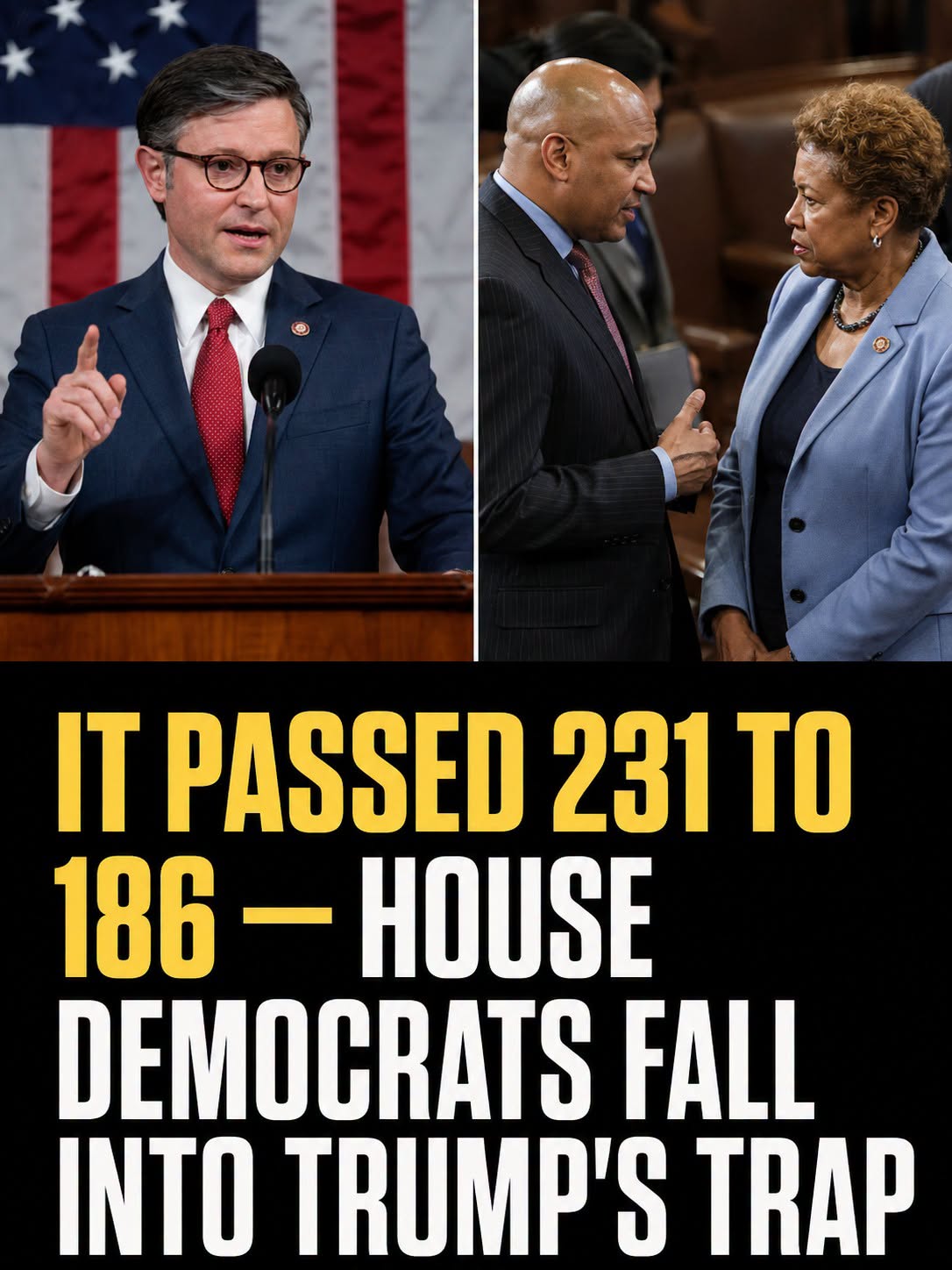

In a strong show of resolve to protect American taxpayers, the U.S. House of Representatives passed legislation targeting illegal immigrants who defraud welfare and public benefits programs, advancing the measure over fierce resistance from House Democrats.

Lawmakers voted 231-186 to approve the Deporting Fraudsters Act, with all 186 Democrats in opposition.
The bill, introduced by Rep. David Taylor, R-Ohio, would amend the Immigration and Nationality Act to make fraud involving public benefits an explicit deportable offense for noncitizens.
Republicans framed the legislation as a common-sense step to ensure that those who abuse taxpayer-funded programs are swiftly removed from the country and permanently barred from returning.
“If you admit to or you’re convicted of fraudulently receiving public benefits, you are out of here on the next plane and can never return,” Rep. Tom McClintock, R-Calif., said during debate on the House floor.
Democrats largely opposed the bill, arguing that existing law already allows for the deportation of noncitizens convicted of fraud.
They characterized the legislation as unnecessary and duplicative.
“Another week, another redundant and completely unnecessary immigration crime bill,” Rep. Jamie Raskin, D-Md., said.
Democrats also raised concerns about due process, arguing the bill could allow for deportation before a criminal conviction is secured.
They warned that such a provision could prevent alleged victims from having their cases heard in court.
“By bypassing the conviction requirement, this legislation would hand a liberal get-out-of-jail free card to immigrants who commit fraud by deporting them without going through the criminal justice system and giving their victims a day in court,” Raskin said.
Republicans pushed back on that claim, saying the bill does not prevent criminal prosecution before removal and maintains existing legal processes.
GOP lawmakers argued that the measure strengthens enforcement by closing perceived loopholes.
The bill now faces long odds in the Democrat-controlled Senate, where it is expected to encounter significant opposition.
Most legislation in the upper chamber requires 60 votes to advance.
Separately, Republican National Committee Chairman Joe Gruters signaled a dramatic shift in the financial battlefield ahead of the midterms, telling Breitbart that Republicans could outspend Democrats for the first time in modern history.
Gruters argued Republicans are entering the cycle with significantly stronger financial positioning and unprecedented coordination across the conservative movement.
Host Mike Slater asked Gruters to put the reported $70 million Democrats spent in Virginia’s recent redistricting battle into perspective.
“How much money is that for the parties?” Slater asked.
Gruters responded by painting a bleak financial picture for Democrats.
“The DNC has minus 4 million [dollars], and it wasn’t the DNC that plowed $70 million: It was the collective,” Gruters said.
“So, if you look at the collective on the right, we may have $800 million,” he continued.
“The collective on the left may have $350 million, and when you have the court, there’s gonna be a court case that is ruled on in the next week or two, coordinated campaign limits, which will magnify that, which will allow full coordination and allow the parties to spend at the candidate rate, which is massive for us,” he said.
Gruters said the financial landscape could mark a historic break from previous election cycles.
“When you have that financial advantage, people, you know, people don’t know that the Democrats routinely spend more than us on election cycles, because they have more massive donors and that will write massive checks,” he said.
“But this time, this cycle [we] will either spend a parity or will outspend them, and that’s never happened before,” he added.
According to Gruters, the RNC itself is in far stronger shape than the Democratic National Committee.
He said the RNC currently has “about $125 million” on hand compared to what he described as negative cash reserves at the DNC.
“Our Republican National Senatorial Committee, let’s say, has $80 million. House committee has $80 million,” he said.
This article may contain commentary which reflects the author’s opinion.